
Katy Warriner of Warriner Leather: Heritage Craft, Modern Purpose

Katy Warriner’s journey into leatherwork is one defined by persistence, patience, and a return to a childhood ambition that never fully left her.
From an early age, she knew she wanted to become a master saddler. Life, as it often does, took her in other directions for a time, but that original ambition eventually resurfaced in her thirties and set her on a path that would reshape her career entirely.

1. How did you originally get started in leatherwork and what led you into saddlery?
It all started with the dream of a 12-year-old girl who wanted to become a master saddler.
That dream stayed with me for years, but life took me in different directions before I eventually found my way back to it. My true journey into leatherwork didn’t begin until I was 30 years old, when I attended a two-day leatherworking course with John Hanger, formerly of Tanner Bates. That weekend completely changed the course of my life.
I became completely obsessed with leatherwork and spent the following years teaching myself through books, online tutorials, videos, and countless hours of trial and error. Looking back at my early work now, it was truly awful—but I absolutely fell in love with the process of learning and improving.
At 35, I finally decided to pursue the traditional path I had dreamed about as a child and enrolled at The Saddlery Training Centre under the guidance of Master Saddler Mark Romain. In 2024, I qualified as a saddler, bridle maker, and harness maker.
While I don’t focus heavily on traditional saddlery commissions today, that training forms the backbone of everything I create. The techniques I use in my belts, bags, dog collars, trugs, cases, and bespoke commissions are deeply rooted in traditional harness making. I often describe my work as heritage leather goods with a modern purpose—traditional craftsmanship designed for everyday life.

2. You’ve trained traditionally—how important is that foundation in your work today?
It’s absolutely everything.
Without traditional craftsmanship, we wouldn’t have the leatherwork we create today. These
techniques have survived centuries for a reason—they work. Traditional hand stitching, edge
finishing, and harness techniques require patience, discipline, and precision, and they can be
incredibly difficult to master.
I firmly believe people should learn the hard way first. Understand why something is done
traditionally, build strong foundations, and then adapt modern methods where they make sense. There’s enormous value in understanding the history and reasoning behind the craft before trying to speed things up.
That traditional training gave me a huge respect for craftsmanship. It taught me patience,
discipline, and pride in workmanship—values that I now carry into every single item I create. I
genuinely wouldn’t be the maker I am today without it.

3. Which items do you find the most satisfying to make and why?
I love making tubs, cases, horse harnesses, and knife sheaths—but belts will always have a
special place in my heart.
Belts are such simple objects, yet they’re part of people’s everyday lives. They’re practical,
timeless, and often overlooked until someone experiences what a truly handmade belt feels like compared to a mass-produced one. I love creating something people use daily that can
genuinely last decades.
My case, tub, and knife sheath work feels slightly different. Those pieces often feel like objects from another era—something deeply nostalgic and rooted in a forgotten time. There’s something incredibly satisfying about creating pieces that feel both functional and historic.
Those projects also allow me to be highly creative with shape, construction, and design. And of course, harness work will always remain deeply meaningful to me because that was where the original dream began.

4. What are the small details people may not notice but you care about most?
Stitching—always stitching.
If hand stitching is even slightly uneven, it shows immediately. One small wobble can completely change how refined a finished piece feels. I think customers often don’t realise just how much time, precision, and patience goes into hand stitching properly. Every hole is prepared carefully, every stitch pulled consistently, and every line needs to feel clean and intentional.
Beyond the craftsmanship itself, I think people often underestimate how much goes on behind the scenes of running a small creative business.
I wear every hat—maker, photographer, website designer, SEO strategist, newsletter writer,
product developer, social media manager, customer service, and bookkeeper. I’m naturally a
maker—I’d happily spend every day in the workshop—but modern business requires so much
more than simply creating beautiful things.
I’m not naturally sales-driven, and I’m definitely not naturally tech-minded, so learning website
design, SEO, photography, email marketing, and multiple software systems has been incredibly challenging. It can feel exhausting and overwhelming at times, but I pour my entire self into this business and hope customers feel that authenticity.

5. You use oak bark tanned leather—what draws you to that over other options?
Its history is what draws me in first.
J&FJ Baker in Colyton, Devon is the last remaining oak bark tannery in the country, and it
happens to be in the same county I live in. That connection feels incredibly special to me.
The leather itself is beautiful to work with—it’s rich, natural, durable, and develops an incredible patina over time—but what truly fascinates me is the heritage behind it. The tanning process is slow, traditional, and deeply rooted in British history.
Walking into that tannery feels like stepping back in time. It feels as though the walls are
whispering stories from generations gone by. In today’s fast-paced world, it feels like a
sanctuary.
I feel incredibly fortunate to have built a relationship with the team there and to personally visit the tannery to select the hides I work with. That connection matters enormously to me because every piece I create carries a story that begins long before it reaches my workshop.

6. Who or what have been your biggest influences?
I owe a huge amount to several people throughout my career.
Master Saddler Mark Romain has been one of the biggest influences in my life. Without his
guidance, patience, and knowledge, I simply wouldn’t be the maker I am today.
John Hanger from Tanner Bates was also hugely influential. That two-day leatherworking course I attended with him over a decade ago completely changed my life and gave me my first proper introduction to leatherwork.
In the harness world, I deeply admire makers like John MacDonald, Francis Roche, and Catrien Coppens. Their work is extraordinary and continues to inspire me daily.
Nigel Armitage has also had a huge influence on my case and box making work. His precision
and understanding of pattern design is remarkable.
And finally, the world of film and television has had a lasting impact on me. As a child, I was
mesmerised by beautifully crafted saddlery, armour, and leather props in period dramas and
blockbuster films. That world absolutely influenced my original desire to work in saddlery, and
today I’m incredibly fortunate to now work within the film and television industry as both a
saddler and props maker—something that feels very full circle.

7. What are you working on at the moment?
I’m currently working on one of the most exciting commissions of my career.
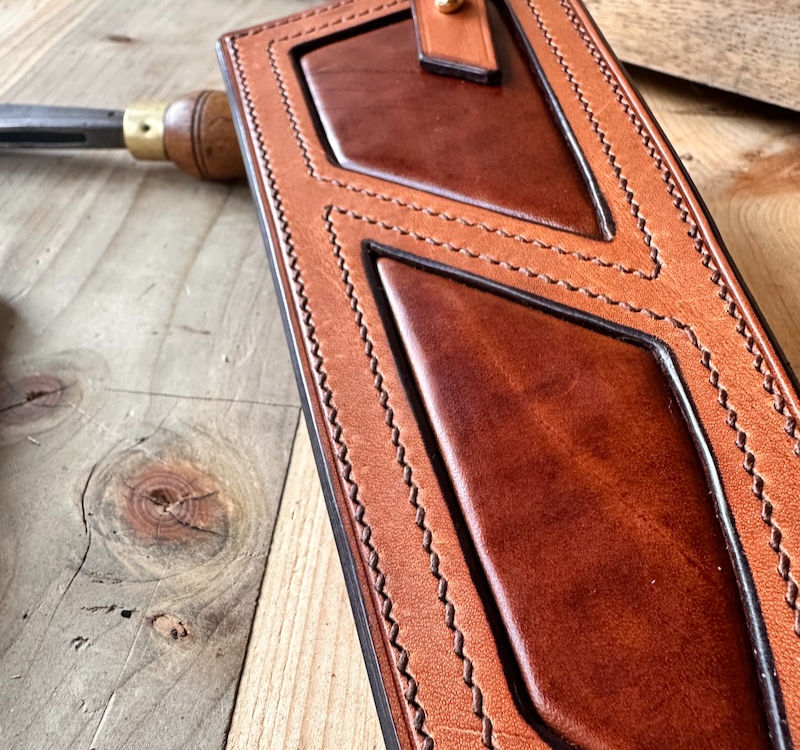
I’ve been commissioned by Pristine Panel Works to design and create bespoke leather interiorcases for the R33 Stradale sports car, of which only 33 will ever be made.
It’s an incredible honour to be part of something so exclusive. The R33 Stradale feels deeply
aligned with my own work—analogue, timeless, beautifully crafted, and built with extraordinary attention to detail.
Projects like this allow me to merge traditional craftsmanship with modern luxury in a really
exciting way.
8. There’s a lot of fast, low-cost leather goods out there—how does your work sit against
that?
My work sits in complete opposition to fast consumption.
These pieces are designed to last decades. They’re made slowly, intentionally, and with
extraordinary care using materials that are chosen for longevity.
Yes—they cost more, but they should. Customers are paying for years of training,
craftsmanship, material sourcing, design work, and countless hours of handwork.
I often tell customers that they can buy multiple £30 belts throughout their lifetime—or they can invest once in something that lasts forever.
Buy well once and reap the benefits for years. That philosophy extends far beyond leather.

9. What would you say to someone starting out?
Practice relentlessly.
Then practice even more.
My early work was terrible, but improvement only comes through repetition, patience, and
consistency. There’s no shortcut.
At the same time, I’d encourage people to think carefully before turning a hobby into a business. I sometimes miss simply creating for fun.
Running a business can be incredibly difficult, and sometimes preserving the joy of a hobby can be far more valuable than monetising it too quickly.

10. What five tools would you recommend to someone starting out?
The first thing I always tell people is that you absolutely do not need to spend a fortune on tools.
There are so many beautifully made, highly polished tools on the market now that are incredibly Instagram-friendly—but they can be wildly expensive and often unnecessary when you’re starting out. It’s also worth thinking about tools that can perform multiple jobs rather than buying specialist tools for every single task.
My five essentials would be:
A diamond stitching awl
Learn to stitch the traditional way first. It’s harder, slower, and far more frustrating in the
beginning—but you’ll be incredibly grateful for that foundation later on.
Good stitching irons
I’d recommend 7spi (roughly 3.8mm) as a great all-round stitch size. It works beautifully across
wallets, belts, bags, and smaller leather goods.
A good knife
Over time, you’ll likely collect several knives for different jobs, but a reliable basic knife is all youreally need when starting out.
A sharpening stone and strop
These are probably the most used tools in my workshop. Learn how to sharpen your tools
properly—it will completely transform your work.
A quality edge beveler
This is one area where I do think it’s worth spending a little more. A poorly made beveler can
make edge finishing frustrating and ruin your work. A good number one beveler will do almost
everything you need when starting out.
Ultimately, your skill matters far more than expensive tools ever will.

11. What are you planning to focus on next?
Right now, one of my biggest focuses is education.
I’m currently filming my online course called Apprentice to Artisan: Leatherworking 101,
which is a self-paced digital course designed to teach people the true foundations of
leatherwork.
This isn’t a “follow along and make exactly what I make” type of course. It’s designed to teach
the real fundamentals—understanding leather, tools, stitching, problem solving, avoiding
common mistakes, and learning how to think like a maker.
I want students to develop their own style rather than becoming replicas of someone else’s
work. I think there’s huge value in teaching people how to understand the craft properly so they can eventually find their own creative identity.
Alongside education, I’m continuing to grow Warriner Leather through bespoke commissions,
film and television work, and expanding my product collections. My long-term goal is to continue preserving traditional British leathercraft while making it feel relevant and accessible for modern life.
At the heart of everything I do is the desire to create meaningful things—whether that’s a
handmade belt someone wears every day, a bespoke commission that becomes a family
heirloom, or teaching someone a skill that could change the course of their life in the same way leatherwork changed mine.

Thank you
A huge thank you to Katy Warriner for taking the time to share her story and insights into her work at Warriner Leather.
It would be a real pleasure to visit her workshop one day and see this level of craftsmanship up close.
You can explore more of her work here:www.warrinerleather.co.uk
And follow her on Instagram:@warrinerleather


I appreciated how the author managed to organise the information logically. The concepts are explained gradually and are easy to follow. I have already forwarded this article to those working in the same field. It is a text that provides a clear and well-organised view of the topic.