
From Repairing Cycling Shoes to Bespoke Shoemaking

A Q&A with Hand-Welted Shoes UK
We recently spoke with Nick Battersby, the maker behind Hand-Welted Shoes UK, a bespoke shoemaker producing fully hand-welted shoes and boots, while also sharing the process with thousands of viewers on YouTube.
What stood out straight away was how his journey began: not through formal training, but by repairing a single pair of cycling shoes.
In this Q&A, he talks about how he got started, what people misunderstand about shoemaking, and why good tools matter more than most realise.
Getting Started in Shoemaking
For anyone who hasn’t come across Hand-Welted Shoes UK yet, how would you describe what you do and what originally drew you into shoemaking?
I make bespoke hand-welted shoes and boots by hand, and I also make videos for YouTube showing the full process. Alongside that, I teach people the methods I use, both through tutorials on YouTube and in person or remotely.
I was drawn into shoemaking purely by accident. I had a pair of cycling shoes I loved where the seam had gone, so I picked up a needle and thread and stitched it back together. My fingers looked like pincushions afterwards, but surprisingly I really enjoyed it.
From there I looked for similar things to do. I resoled a leather boot, and then it was an obvious next step to try making my own pair. I’ve never looked back since.
Are you currently working as a full-time shoemaker?
Yes — alongside teaching and YouTube.

Teaching and Sharing the Craft
You mentioned that you have students, could you tell me a little more about that?
I’m trying to add as many tutorials as possible to my YouTube, but it’s always better to learn from someone with experience rather than just from a video.
So I also offer shoemaking courses that are tailored to each individual student.
For example, I’m currently teaching a student in Poland. He’s doing it purely as a hobby, and all the teaching is done remotely.
Your YouTube channel has a large number of subscribers, what made you decide to share your work publicly?
I enjoy learning new things. I had never filmed or edited video before, and thought it could be interesting to learn.
What kind of response from viewers has meant the most to you personally?
I really like hearing from people who have found the videos helpful in their own journey to make a pair of shoes.

What People Get Wrong About Shoemaking
What do you think people misunderstand most about handmade shoes and traditional shoemaking?
A lot of people assume they can make a perfect pair of shoes the first time they try. Most of the techniques I use are fairly simple, and they also look fairly simple to do.
But being able to repeat each process consistently without making a mistake takes a long time to master. And if you make a single mistake, it can ruin the shoes you’re making.
For example, I use a Japanese skiving knife to trim the leather heel, and this is one of the final stages of making a pair. If you slip with the knife, it can slice the upper leather and completely ruin the shoe.
And yes, that did happen to me once when I was learning.
Tools of the Trade
What were your first impressions when you started using our Japanese Skiving Knife, and how did it compare to tools you’d used previously?
I had previously been using a cheap Japanese skiving knife from China. My first impressions of using a George Barnsley Japanese skiving knife were:
The handle is fixed securely and doesn’t wobble
The blade is almost double the thickness of my old one
It leaves a much cleaner cut when trimming sole leather and heels, which makes sanding and burnishing quicker and easier
It’s much sharper, easier to sharpen, and holds its edge far longer, probably at least ten times as long
What other George Barnsley tools do you have on your workbench?
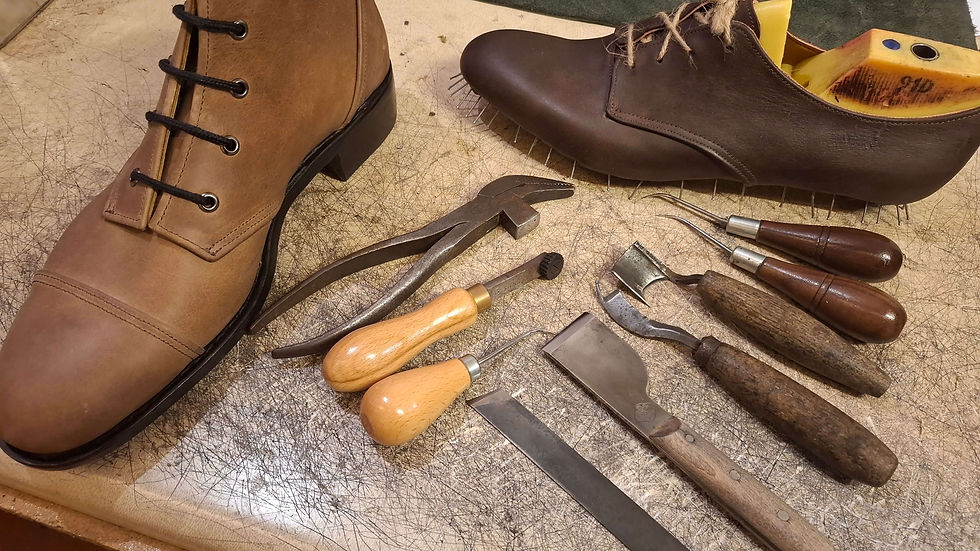
An old set of lasting pliers
Advice for Beginners
If you could give one piece of advice to someone investing in their first serious hand tools, what would it be?
Learn how to maintain them yourself.
Your knife can be made from the best quality steel, but if you don’t know how to sharpen it, it will be useless.
For someone new to shoemaking, which tools would you suggest investing in first, and which can wait until later?
I use a selection of different knives, but if I had to choose just one, it would be a Japanese skiving knife. I’d also say curved awls are essential.
For your first pair, you can manage with a standard set of pliers. When you move on to your next pair, you’ll really appreciate the difference when you upgrade to proper lasting pliers.
If someone reading this is considering learning shoemaking, what would you say to encourage them to take the leap?
Don’t wait, just start!
Your first pair won’t be perfect, no matter how much research you do beforehand. But you’ll see a huge improvement when you come to make your second pair.

Final Thoughts
It’s always interesting to hear how different makers come into the craft, especially those who’ve learned through doing.
You can find more from Hand-Welted Shoes UK on YouTube, where he shares detailed insights into the full shoemaking process.


I appreciated how the author managed to organise the information logically. The information is well documented and seems reliable. I printed some parts to have them available while working. It is not easy to find information so complete and well presented on this topic.